
Traditional one-size-fits-all assessments have long failed to capture the true potential of individual learners. Every student brings unique strengths and learning styles, yet most assessments treat them identically. This disconnect has created barriers that prevent educators from truly understanding what their students know and can do.
Artificial intelligence is changing this landscape dramatically. Machine learning, generative AI, and natural language processing are dismantling traditional barriers to personalized assessment, creating opportunities for more meaningful evaluation methods that serve both K-12 and adult learners.
Traditional Assessment Limitations
Historical barriers to personalized assessment include massive resource requirements for creating individualized tests, limited adaptive capabilities in paper-based assessments, narrow response formats constrained by scoring limitations, and delayed feedback that prevents real-time instructional adjustment. These constraints have made truly personalized assessment practically impossible at scale.
How AI Technologies Enable Personalization
Machine Learning: Intelligent Adaptation
Machine learning algorithms excel at pattern recognition, enabling truly adaptive assessments. These systems analyze student response data to optimize question sequences, adjust difficulty in real-time, and predict learning gaps before they become obstacles. Instead of fixed question sets, AI selects items that provide maximum information about each student's understanding.
Generative AI: Expanding Possibilities
Generative AI revolutionizes assessment by creating multiple question versions that test the same concepts with different contexts, automatically evaluating open-ended responses with increasing accuracy, and generating content that reflects students' interests and cultural backgrounds while maintaining learning objectives.
Natural Language Processing: Understanding Student Thinking
NLP technologies enable conversational assessment interfaces where students can explain their thinking naturally, provide multilingual support that removes language barriers, and analyze student confidence levels and emotional states through language patterns.
Enabling Formative Use of Assessment Data
AI-powered personalized assessments enable the research-backed principles of effective formative assessment. Research consistently demonstrates that frequent, relevant, and timely feedback is critical for learning, as it allows students to adjust their thinking and enables teachers to modify instruction in response to student needs. AI makes this approach practical at scale by providing continuous learning feedback, enabling real-time instructional adjustment, capturing learning processes rather than just final answers, integrating scaffolded support when students struggle, and focusing on individual growth rather than comparative ranking.
Real-World Success: The UMass ASAP Case Study
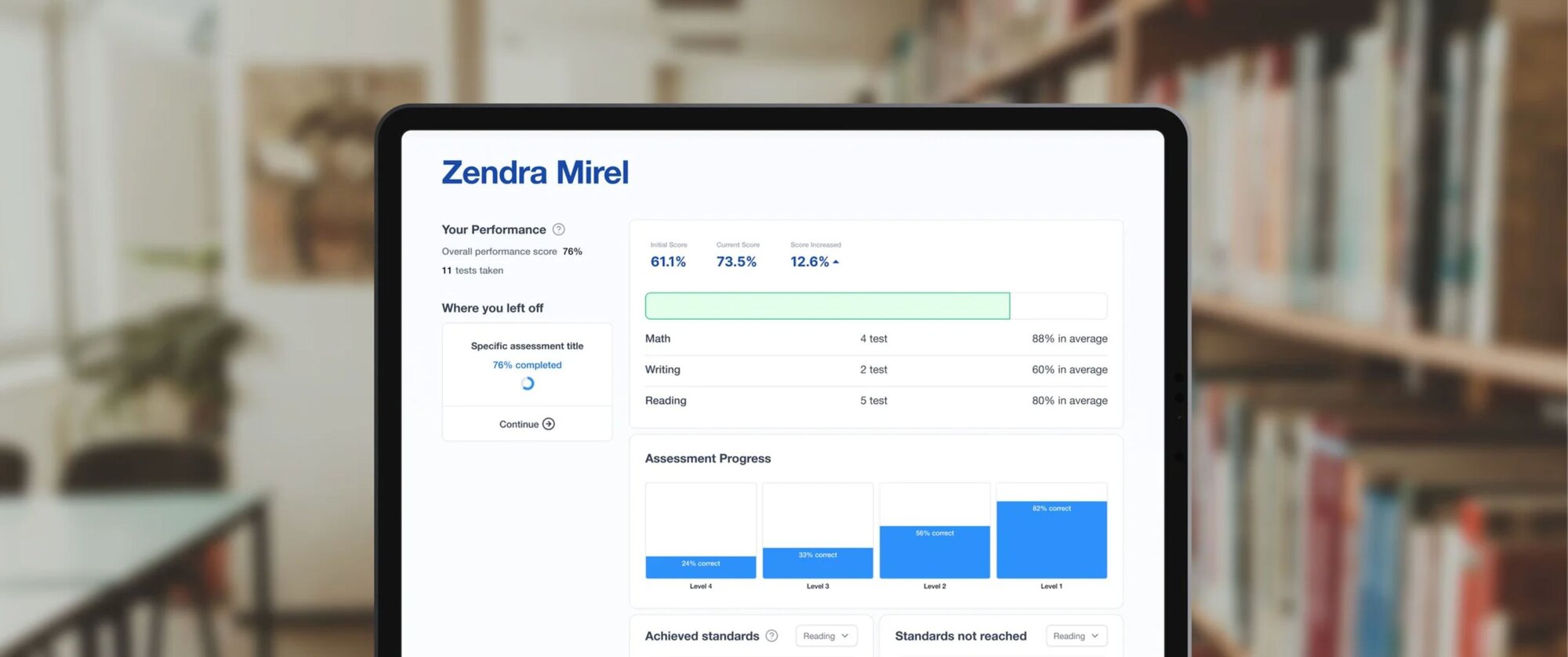
The University of Massachusetts Adult Skills Assessment Program (ASAP) partnership with Monstarlab demonstrates successful implementation of personalized assessment technology. The team at UMass' Center for Education Research was interested in moving beyond conventional assessment methods to provide adult learners with assessments that were more culturally relevant and aligned to their personal preferences for language and a simplified user experience.
Monstarlab helped UMass through the crawl and walk phases of implementation, starting with stakeholder alignment and infrastructure building rather than rushing to complex AI features. The partnership focused on user-centered design, creating intuitive interfaces and moderate personalization features while building scalable architecture designed to serve over 10,000 learners.
While the platform now includes basic adaptive capabilities and white-labeling potential, achieving full personalization through sophisticated AI systems and advanced analytics requires additional development. The completed work provides essential infrastructure and demonstrates significant value, while preparing the foundation for future advanced AI implementation.
A Practical Implementation Framework
Organizations can follow a crawl, walk, run approach to implement personalized assessments:
Crawl Phase: Establish basic infrastructure, begin systematic data collection, provide staff training on digital assessment tools, and implement small-scale pilots with simple adaptive features.
Walk Phase: Integrate basic machine learning for adaptive question selection, introduce NLP for simple response analysis, develop enhanced data analytics capabilities, and scale successful pilots while maintaining careful evaluation.
Run Phase: Deploy advanced AI systems for comprehensive personalization, implement sophisticated analytics for predictive modeling, and achieve seamless integration across all educational technologies.
Steps Toward Success
K-12 Schools can start by building robust networks, aligning personalized tools with state standards, developing special education accommodation capabilities, and creating parent communication strategies about AI-enhanced assessment approaches.
Higher Education can begin with balancing AI benefits with faculty autonomy, developing research capabilities to validate effectiveness, integrating with student success initiatives, and ensuring accreditation compliance.
Adult Learning Organizations can focus on creating flexible, accessible interfaces, developing industry-relevant content, implementing competency-based evaluation approaches, and building scalable, cost-effective solutions.
EdTech Companies can prioritize user-centered design grounded in educational theory, implementing ethical AI with bias detection, ensuring robust data privacy and security, providing comprehensive professional development, and investing in research demonstrating product effectiveness.
Looking Forward
The transformation to personalized assessment represents a fundamental shift from summative judgment to formative support. By removing traditional barriers of scale and resource constraints, AI technologies enable assessments that serve learning in real-time rather than simply documenting it after the fact. This reduces anxiety and stress while providing continuous support and multiple opportunities for improvement.
The future of personalized assessment isn't just about better technology—it's about creating educational experiences that honor each individual's unique learning journey while providing educators with unprecedented insights to support student growth and success.