Software development teams are under constant pressure to ship faster without letting quality slip. Code review has always been one of the most effective checkpoints for catching problems before they reach production, but it's also one of the most time-consuming parts of the development process. A pull request sits waiting for review. A senior developer is pulled in two directions. A deadline moves. And somewhere in the middle, something gets missed.
AI-assisted code review is changing that dynamic. Tools that read a pull request in context, check it against best practices, and return recommendations before a human reviewer ever opens the file are quickly becoming a standard part of how teams manage delivery risk. But the more useful story isn't what the tool does. It's what changes on a team once it's actually in place.
That's the story Clarissa Estremos, Senior Project Manager and Full-Stack Developer at Monstarlab, can tell firsthand.
The Project Manager's Perspective
Clarissa led a client engagement, a commercial Karaoke Web System, from both sides of the table: as the person managing delivery, and as a developer working inside the codebase. Her team added an AI reviewer (GitHub Copilot, in this case) directly onto every pull request. Here is what she observed about how it changed the way the team worked, and what that means for clients weighing AI-assisted development.
1. AI Review Became the First Line of Defense, Not the Last Resort
The most immediate benefit Clarissa observed was in the back-and-forth between engineers and tech leads. During the maintenance phase of the project, tech lead allocation was reduced, which meant pull requests needed to move forward with less supervision than usual. Copilot filled that gap. It also proved its value during urgent production hotfixes, covering the moments when a tech lead was unavailable but a fix still had to be reviewed, merged, and deployed the same day.
What surprised the team was how quickly that dynamic shifted. Copilot was introduced as a supplementary reviewer, a tool to assist the process. In practice, it became the first check on every pull request, with the tech lead stepping in only where genuine judgment was needed.
2. Accountability Went Up, Bottlenecks Went Down
From a project management standpoint, the most visible change was in how the team operated day to day. Accountability among mid-level and junior engineers increased, while their dependency on senior developers decreased. Fewer pull requests sat idle waiting for a reply. When the client needed urgent action, the team could move quickly because Copilot had already handled the first-pass review, and fixes went out the same day.
Code quality tracking also improved in a less obvious way. The same issues a tech lead had already flagged in previous reviews stopped resurfacing, because Copilot raised that feedback automatically on every pull request rather than depending on someone remembering to bring it up again. Every line of code got checked, including the parts that might have been skimmed in a time-pressured manual review.
3. What a Client Should Actually Understand
When it comes to what a business leader needs to know before committing to AI-assisted development, Clarissa's perspective is direct and worth quoting in full:
"AI review adds a layer to the process. It does not remove one. Human review is still there. What changes is that a consistent first-pass check now runs on every pull request, so quality no longer depends on whether a senior engineer had time that day. The practical effect on the engagement is speed without a trade-off in standards."
— Clarissa Estremos, Senior Project Manager and Full-Stack Developer, Monstarlab
That last line captures the business case precisely. AI-assisted code review is not about cutting corners or reducing the team. It is about making the existing process more reliable, more consistent, and less dependent on individual availability.
What This Actually Looks Like Day to Day
Adding an AI reviewer to a pull request isn't the same as running a linter or a static analysis tool, which only check for known rule violations. A capable AI reviewer reads the code in context, across every file changed in the pull request, and returns specific recommendations tied to those lines: security considerations, performance patterns, readability, and alignment with established practices. A developer reviews the suggestions, accepts what's useful, and the reviewer can run again after changes are made to confirm nothing new was introduced.
It's a review cycle that used to depend entirely on a senior developer's availability. The AI reviewer doesn't replace that person, but it handles a meaningful amount of the groundwork before they ever open the pull request, and the productivity gains are measurable: in controlled research from Microsoft, professional developers using GitHub Copilot completed coding tasks in roughly half the time of a control group.¹ That kind of gain compounds across a team managing multiple features and release cycles at once.
How It Plays Out on the Karaoke Web System
Monstarlab's team applied an AI reviewer to every pull request on the Karaoke Web System project, an environment where code quality, feature consistency, and release reliability directly affect how users experience the product.
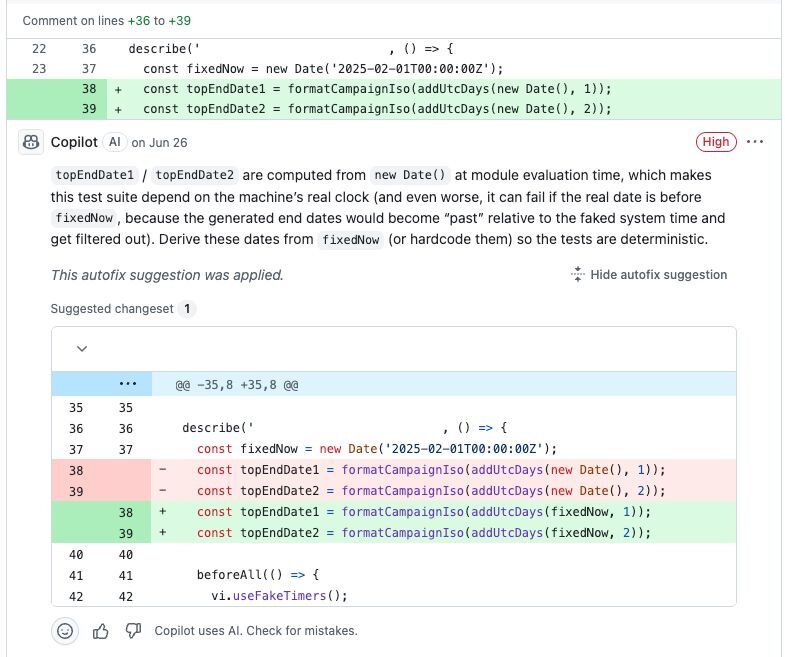
Figure 1: Github Copilot code review suggestion for a Commercial Karaoke System project
The development workflow involved frequent pull requests as features were built and iterated on. Bringing Copilot in as a reviewer changed two things in particular. First, it cuts down the back-and-forth between developers and human reviewers. Common issues were already caught and addressed before a senior team member looked at the code, so reviews could focus on the things that actually needed experienced judgment. Second, it gave the team a consistent baseline for code quality across every pull request, which is harder to maintain manually when several developers are working on different features at the same time.
The iterative loop of suggest, accept, and re-run also meant the codebase improved with each pull request, rather than only during dedicated cleanup sprints later in the project.
Why This Matters Beyond the Code
When business leaders ask about AI tools in software development, the conversation usually goes straight to speed. And yes, faster delivery is real. The data backs it up. But for a client making decisions about a development partner, the more important benefit is consistency.
When code is reviewed by a human alone, quality depends on that person's availability, their familiarity with the codebase, and how much bandwidth they have that day. A busy sprint or a tight deadline can shrink the review window in ways that let things through. Copilot does not have those variables. It reviews every pull request with the same level of attention, against the same standards, every time.
For a client, that consistency shows up in practical ways: fewer bugs found after launch, more predictable release timelines, and a codebase that costs less to maintain over time. Those are business outcomes, not just technical ones.
It also changes how senior developers spend their time on a project. When Copilot handles the routine checks before a pull request reaches human review, the senior developer's attention goes to the things that actually need it: the architectural decisions, the edge cases, and the judgment calls that no AI tool can make yet.
AI Code Review Is Not a Shortcut. It Is a Standard.
Teams that treat GitHub Copilot code review as a time-saving trick are getting only part of the value. The deeper shift is that AI review is becoming a baseline quality standard, the same way version control and automated testing became standard practice in the years before.
Software development teams that build this into their workflow now are not just moving faster. They are building a more consistent, more defensible development process that clients can rely on and that scales without proportional increases in headcount or review overhead.
For organizations looking to partner with a development team that brings AI-assisted workflows into the project from day one, Monstarlab has the technical depth and project delivery experience to make that a practical reality rather than a pilot program.
----
Subject Matter Expert: Clarissa Estremos, Senior Project Manager at Monstarlab Philippines
—-
End Notes
¹ Microsoft Research. The Impact of AI on Developer Productivity: Evidence from GitHub Copilot.