Modern payment systems don’t fail gracefully by default. They fail silently, asynchronously, and repeatedly. Duplicate charges, missing orders, and inconsistent payment states are signals of a core problem, they are the predictable result of an unprotected distributed system.
In this article, we’ll explore how to build fault-tolerant payment systems using Stripe, focusing on two critical concepts:
- Idempotency → prevents duplicate charges
- Webhooks → ensures eventual consistency

The Real Problem: Why Double Charges Happen
Consider the following sequence of events:
- A user initiates payment by clicking “Pay Now”
- The backend sends a charge request to Stripe
- Stripe successfully processes the transaction
- The server crashes before responding
- The client retries the request
Result: Customer is charged twice.
This scenario isn’t a rare case, it’s an expected failure mode in distributed systems.
- Before processing (safe retry)
- During processing (danger zone)
- After success but before response (most dangerous)
Without protection, retries = duplicate payments.
A. Idempotency:Your First Line of Defense
A.1. What is Idempotency?
An operation is considered idempotent when executing it multiple times produces the same outcome as executing it once. Applied to payments, this means a “charge order” transaction should result in exactly one charge, regardless of how many retry attempts are made.
A.2. How Stripe Solves This
Stripe’s idempotency mechanism works as follows: a unique key is generated per payment attempt (eg: order_123) and transmitted with every request. Stripe stores the result of the first request and replays that cached response for any subsequent request bearing the same key, ensuring the same input always yields the same output, with no duplicate charge.
A.3. Basic Flow
Client → Backend → Stripe
(Idempotency-Key: order_123)
If retried:
Client → Backend → Stripe
(Idempotency-Key: order_123)
→ Returns cached result
A.4. Backend Idempotency (Don’t Rely on Stripe Alone)
While Stripe protects its own API layer, the application layer requires its own idempotency safeguards. Best practice at this level include:
- Use order_id as idempotency key
- Store payment state in DB
- Enforce uniqueness (e.g., unique constraint)
Example state machine:
PENDING → PROCESSING → PAID → FULFILLED
Use DB locking (SELECT FOR UPDATE) to prevent race conditions.
A.5. Common Mistakes
- ❌ Generating idempotency keys on the server
- ❌ Using random keys per retry
- ❌ Not persisting payment state
Keys must be stable across retries and tied to a business entity (like an order).
B. Webhooks:Handling the Asynchronous Reality
The asynchronous nature of modern payment processing is managed through the implementation of webhooks. Because several types of transactions, including 3D Secure authentication, bank redirects, and delayed settlements, cannot be finished instantly. Webhooks are used by Stripe to provide system notifications as these events happen.
B.1. What Are Webhooks?
Webhooks are asynchronous HTTP callbacks that Stripe dispatches to a registered endpoint whenever a payment-related events occur, such as:
- payment_intent.succeeded
- payment_intent.payment_failed
- charge.succeeded
B.2. Critical Truth: Webhooks Are At-Least-Once Delivery
Stripe guarantees that webhook events will be delivered, but does not guarantee that they will be delivered exactly once, which means events can be duplicated, delayed, and can arrive out of order.
B.3. Retry Behavior
If your server fails, Stripe retries multiple times (up to 24 hours) even a timeout triggers a retry.
C. Designing Idempotent Webhook Handlers
Webhook handlers must be designed around a single core assumption: any given event may be delivered more than once.
C.1. Core Strategy
- Store processed event IDs
- Check before processing
- Apply changes safely (not blindly skip)
C.2. Example Flow
Webhook Received → Check event_id in DB
↓
Exists? → Ignore / Return 200
↓
Not Exists → Process → Save event_id
C.3. Advanced Pattern: State-Based Processing
Instead of “skip duplicates,” use state transitions:
Example:
ORDER:
PENDING → PAID → SHIPPED
If webhook repeats:
Already PAID → do nothing (safe to re-run logic)
This is true idempotency (not just deduplication)
D. Putting It Together: Fault-Tolerant Architecture
D.1. High-Level Flow
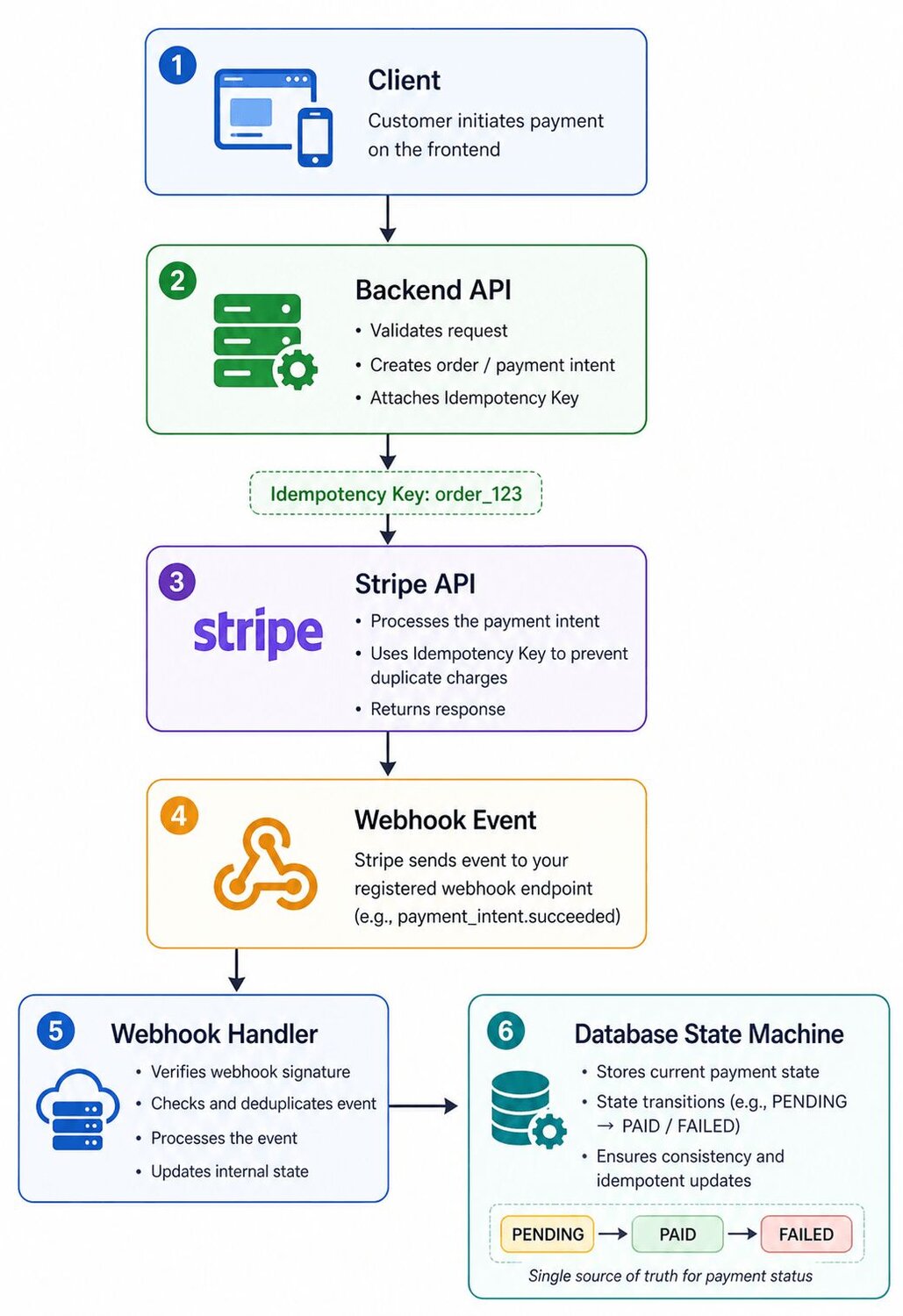
Figure 1. High-level architecture showing how the Idempotency Key is applied throughout the payment processing workflow.
D.2. Key Principles
1. Idempotent API Calls
- Prevent duplicate charges at the Stripe API layer
2. Idempotent Webhooks
- Prevent duplicate side effects from repeated event delivery
3. State Machine
- Ensure consistent transitions, predictable transitions between payment states
4. Eventual Consistency
- Trust webhooks as the source of truth, not the initial client responses
Stripe’s official recommendation is that order confirmation should be triggered only upon receipt of a successful webhook event, not based on the synchronous API response.
Production Best Practices
1. Verify Webhook Signatures
- never trust incoming webhook requests blindly. Always verify Stripe’s signature before processing.
2. Respond Fast, Process Async
- return 200 OK immediately, then process the event in background queue.
3. Log Everything
- log the event_id, payment_intent_id, and order_id for every transaction.
4. Use Retry + Backoff
- handle transient failures gracefully rather than failing immediately.
5. Test Failure Scenarios
- actively simulate network timeouts, duplicate webhooks, and partial database writes during development
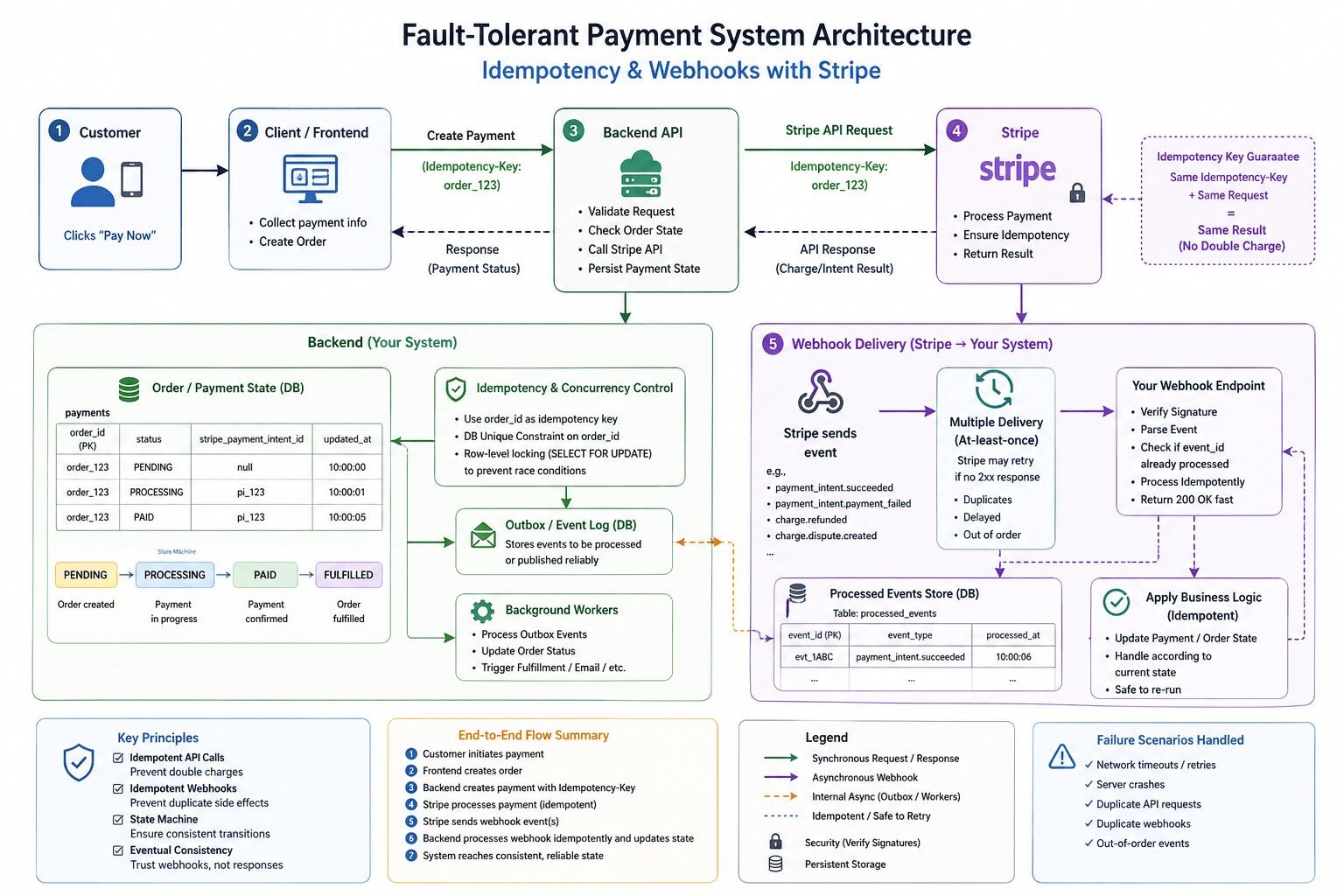
Figure 2. Example architecture illustrating how the application integrates Idempotency and Stripe Webhooks to achieve a fault-tolerant payment system.
A common real-world failure in payment systems occurs when idempotency and webhook deduplication are not implemented. For example, in a system using Stripe, a customer clicked “Pay Now,” the backend successfully created a payment, but the server timed out before responding. The frontend retried the request, and because no idempotency key was used, a second payment was created resulting in a double charge.
At the same time, duplicate webhook events were processed because the system assumed they would only be delivered once, leading to repeated order updates and duplicate fulfillment actions.
The issue was diagnosed by tracing logs that showed multiple payment attempts for the same order within seconds. The fix involved introducing idempotency keys tied to the order ID, enforcing a database-level unique constraint, storing processed webhook event IDs to prevent duplicate handling, and implementing state-based updates so repeated events would not cause inconsistent changes. This transformed the system into a fault-tolerant, retry-safe architecture.
Database vs. In-Memory Cache: Choosing the Right Idempotency Store
When adding layers of protection to a system, performance is always an important consideration. Many developers prefer using in-memory caches because of their fast response times, but what about logs and historical records? An in-memory cache alone has limitations because data can be lost when the cache or database server restarts. In short, it is better to use a persistent database or combine both approaches.
When implementing idempotency at the application layer, choosing between a database and an in-memory cache like Redis involves trade-offs. A database provides strong consistency, durability, and guarantees against duplicates through unique constraints, making it the safest choice for financial transactions, but it can become a bottleneck under high write throughput due to locking and disk I/O.
Redis offers extremely fast performance and handles high traffic efficiently, but it introduces risks such as data loss on restart, key expiration issues, and lack of strong consistency if used alone. In practice, databases tend to struggle under very high concurrency, while Redis can fail in scenarios where idempotency keys expire or are not persisted.
The most reliable approach in production systems is a hybrid model: Redis is used for fast, short-term duplicate detection, while the database serves as the ultimate source of truth to enforce correctness.
Simple Stripe Integration with Idempotency & Webhook Handling in PHP
The following example implementation uses PHP 8, the Stripe PHP SDK, and MySQL with PDO to build a reliable and secure payment processing system. PHP is a strong choice for Stripe integrations because Stripe provides a mature and widely adopted SDK with extensive documentation and support.
This example covers:
- Creating a PaymentIntent
- Apply Idempotency Keys to prevent duplicate charges
- Storing order information in a MySQL database
- Verifying webhook signatures for security
- Protecting against duplicate webhook processing
- Safely update payment statuses
Architecture Flow Diagram
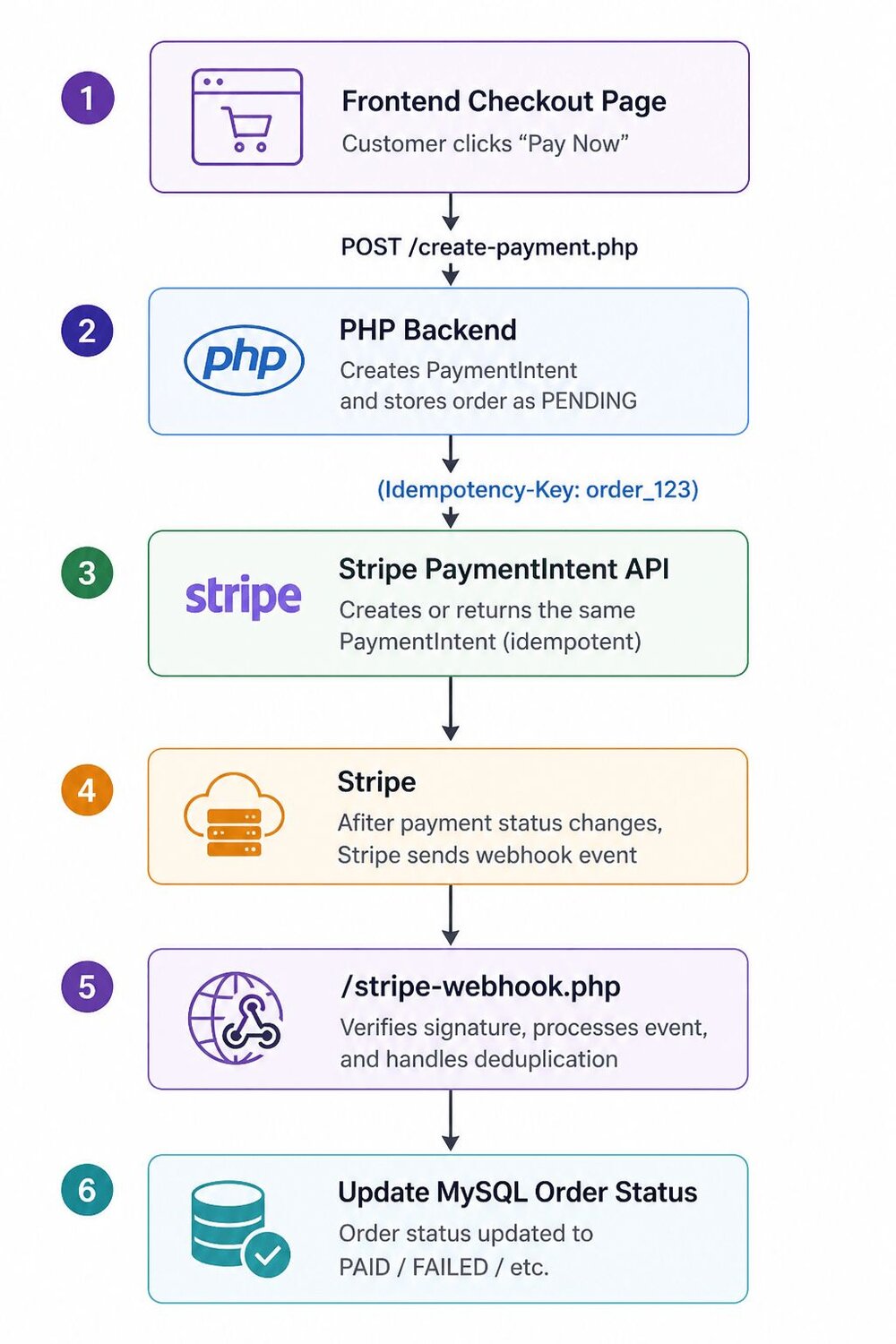
Figure 3. Payment architecture flow demonstrating the implementation of Idempotency Keys with Stripe PaymentIntents and webhooks.
This architecture flow diagram demonstrates a fault-tolerant Stripe payment system designed to handle retries, network failures, duplicate requests, and asynchronous payment updates safely and consistently.
The process begins at the frontend checkout page, where the customer clicks the “Pay Now” button to initiate the payment process. The frontend sends a POST request to the backend endpoint, such as /create-payment.php, which acts as the central coordinator for creating and managing the payment transaction. At this stage, the frontend does not directly trust the payment result; instead, it delegates payment orchestration to the backend for better security and reliability.
Inside the PHP backend, the application creates a Stripe PaymentIntent, which represents the lifecycle of the payment transaction. Before communicating with Stripe, the backend stores the order in a MySQL database with a temporary status such as PENDING. This is important because it establishes an internal record of the transaction even before payment confirmation occurs. During the API request to Stripe, the backend includes an Idempotency Key, such as order_123. The Idempotency Key ensures that if the same request is accidentally retried due to double-clicking the payment button, browser refreshes, network interruptions, or backend retries, Stripe will not create multiple charges. Instead, Stripe recognizes the repeated request and safely returns the same PaymentIntent response, making the payment creation process idempotent and duplicate-safe.
After Stripe receives the request, the Stripe PaymentIntent API either creates a new PaymentIntent or returns the existing one associated with the same Idempotency Key. Stripe then handles the actual payment processing, authentication, and communication with the card network or payment provider. Because payment processing is inherently asynchronous, the application should not rely solely on the immediate API response from the frontend confirmation request. Payment states may change later due to bank processing, authentication flows such as 3D Secure, delayed payment methods, or temporary processing states. For this reason, Stripe uses webhooks as the source of truth for final payment status updates.
When the payment status changes, Stripe automatically sends a webhook event to the backend webhook endpoint, such as /stripe-webhook.php. This webhook mechanism allows Stripe to notify the application about important events like payment_intent.succeeded, payment_intent.payment_failed, or refund-related events. The webhook endpoint first verifies Stripe’s digital signature to ensure the request genuinely originated from Stripe and was not tampered with by a malicious actor. Once verified, the webhook handler processes the event and performs deduplication checks by storing and validating Stripe event IDs. This prevents the same webhook event from being processed multiple times, which is critical because Stripe may retry webhook deliveries if the server fails to respond correctly or experiences temporary downtime.
Finally, after the webhook event is validated and processed successfully, the backend updates the MySQL order record with the final payment state, such as PAID, FAILED, CANCELED, or another business-specific status. This database update becomes the authoritative state of the order within the system. By relying on webhooks and database state transitions rather than trusting only frontend responses, the architecture achieves strong consistency and resilience. This design combines synchronous payment initiation with asynchronous event reconciliation, allowing the system to remain reliable even during retries, duplicate requests, temporary outages, webhook re-deliveries, or client-side interruptions, which are common realities in real-world distributed payment systems.
Why Getting This Right Matters in Production
Treating a payment as a simple request-response cycle is one of the primary causes of reliability failures in modern payment systems. In reality, payments should be treated as workflows that begin with an API request and are finalized through asynchronous event reconciliation using webhooks. Architectures designed with this mindset become significantly more resilient to network failures, retries, and distributed system inconsistencies, whereas systems that ignore it are far more susceptible to duplicate charges and operational failures whenever unexpected issues occur.
Building a fault-tolerant Stripe architecture therefore requires several critical practices: consistently using idempotency keys to prevent duplicate transactions, properly handling repeated webhook notifications caused by retry mechanisms, implementing state machines instead of simple status flags for better consistency, and treating webhooks as the ultimate source of truth rather than relying solely on initial API responses. Together, these practices create a more robust, reliable, and production-ready payment infrastructure.
At Monstarlab Philippines, these principles are applied with the added confidence of having Stripe Certified developers on the team, professionals who have undergone Stripe's official certification program and are equipped to design and implement payment systems that meet production-grade standards. If your business needs a payment infrastructure that is secure, fault-tolerant, and built to scale, get in touch with the Monstarlab Philippines team.
—
Author: Rey Joseph T. Baay, Stripe Certified Associate Developer at Monstarlab Philippines
—-
References: