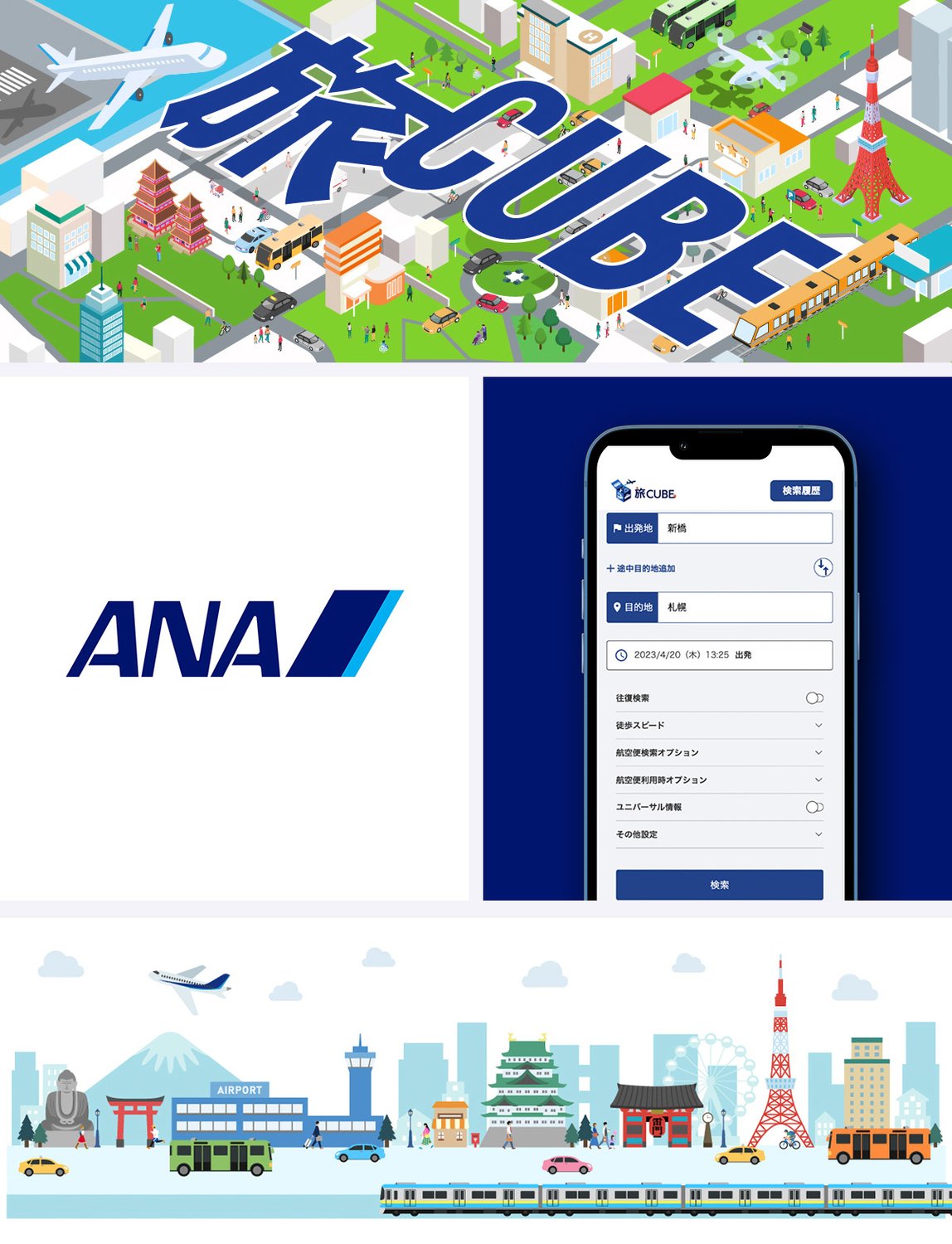
End-to-End Support for ANA's Transportation Platform Service "Tabi CUBE," From Business Strategy and Service Design to Requirements Definition.
Strongly Backed the Significant Renewal of Existing Services in a Short Period
Challenges:
ANA had already been focusing on MaaS, exploring the potential of leveraging digital technology to provide "comprehensive travel services encompassing not only flights but also pre- and post-flight transportation."
While they possessed an existing navigation service, they were considering a significant renewal into a MaaS offering. However, despite having a general concept, they had not yet concretely defined whether it would be commercially viable, what specific services would satisfy a large user base, or what functionalities could be implemented. Therefore, they were seeking a partner to collaborate with them in developing these aspects.
Solutions:
Upon receiving the request from ANA, Monstarlab took on the responsibility for everything from business strategy and service design to the requirements definition stage before full-scale development.
In terms of business strategy, they formulated a plan from the perspective of "what kind of service would be commercially viable." They designed the strategy using various frameworks, including KPI design and monetization methods for the MaaS business.
For service design, they proposed a new service centered on the user experience. Initially, they hypothesized about the actions ANA users take before and after their flights. They then swiftly translated these hypotheses into customer journey maps and flowcharts for visualization. By visualizing the entire service at an early stage, they were able to detail a "good user experience and easy-to-use service" even within a short timeframe. From there, they further refined the service by developing the app's screen design (UI design).
In the requirements definition phase, they defined the functional requirements while verifying whether the service could actually be developed as an app. First, they broke down the service design into detailed use cases, accurately reflecting the user experience in the requirements. Simultaneously, they organized user behavior chronologically, considered where and what data should be acquired and how it should be linked to the data infrastructure, and incorporated this into the development plan proposal.
Furthermore, given that the new service was a platform, they carefully examined various combinations of multiple APIs (*). In particular, for integrations with existing ticket reservation and operational status systems, they prioritized defining the necessary APIs, which contributed to efficient development progress.
*API (Application Programming Interface): A set of rules and specifications that allows different software applications to communicate and exchange data with each other.
Results:
The ability to deliver a comprehensive output within a short three-month period – encompassing strategy, detailed service and screen design, and even complex requirements definition that considered feasibility – was highly valued by the client.
This achievement was made possible not only through the close collaboration between the business, design, and technology teams within Monstarlab but also due to the client's proactive approach and engagement, which fostered active communication between both parties and enabled a unified drive towards project success.
This initiative was released as the new service "Tabi CUBE" in July 2023, and its user base is steadily expanding. Moving forward, Monstarlab will continue to work closely with the client, providing support for the planning and promotion of new digital services.